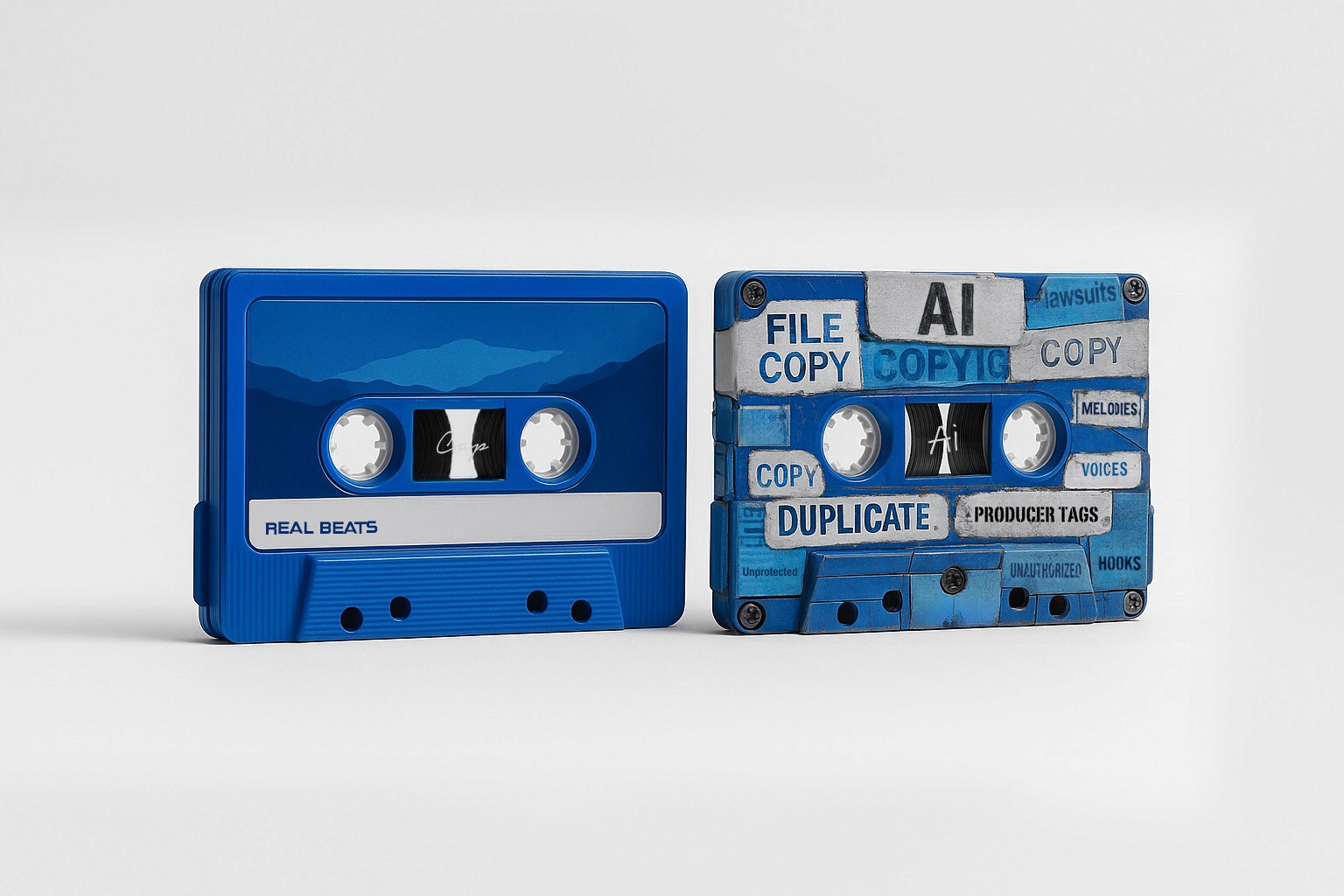
AI music is everywhere. But what are you really risking when your beats are generated with AI?
Every day I get more ads from big generative music platforms.
They make everything look effortless and magical, almost like you can create a full song with one click. They sell the idea that this is where music is heading and that everyone should follow.
But the more I look at what is really happening in the industry, the more I notice something worrying.
The legal issues keep growing, new cases show up every week and somehow the ones paying the price are always the artists.
And that leads to a question many creators overlook until it is too late:
In reality, what are you risking when the beats in your songs are generated with AI?
Do you actually own an AI generated beat? The answer is more complicated than it seems
Many artists believe that generating a beat or a song with AI automatically makes them the owners of whatever came out, either because they pay a subscription to platforms like Suno or Udio, or simply because they wrote the prompt.
But here is where things get surprising.
The reality is that, under most current legal frameworks, you are not considered the legal owner of a beat generated entirely by AI, even when using paid subscriptions
Why?
Because, in many jurisdictions, works created entirely by AI are not currently recognized as having human authorship or clear ownership. behaves almost like it belongs to the public domain from an ownership perspective
At first this might not sound too serious, but the consequences are huge.
If the beat itself is not protected by copyright, it often cannot be registered as an original work and may remain freely usable.
That opens the door for anyone to replicate it, reuse it, distribute it, copy it or even publicly claim ownership over it without you being able to dispute it.
What can be protected is everything you create yourself, like lyrics, melodies, vocal performances or any original human contribution. Those elements can be copyrighted, but any section generated by AI will stay unprotected.
And this raises a very real concern.
If an artist releases a song using their own vocals, but the instrumental was created entirely by AI, without direct human creative input in the beat, and that track becomes successful, a serious issue appears.
The truth is that nothing in the current law prevents this from happening.
And after years in this industry, I have learned that people can get very creative when it comes to doing the wrong thing, especially when there is money involved.
The biggest risks when your beats are generated entirely with AI
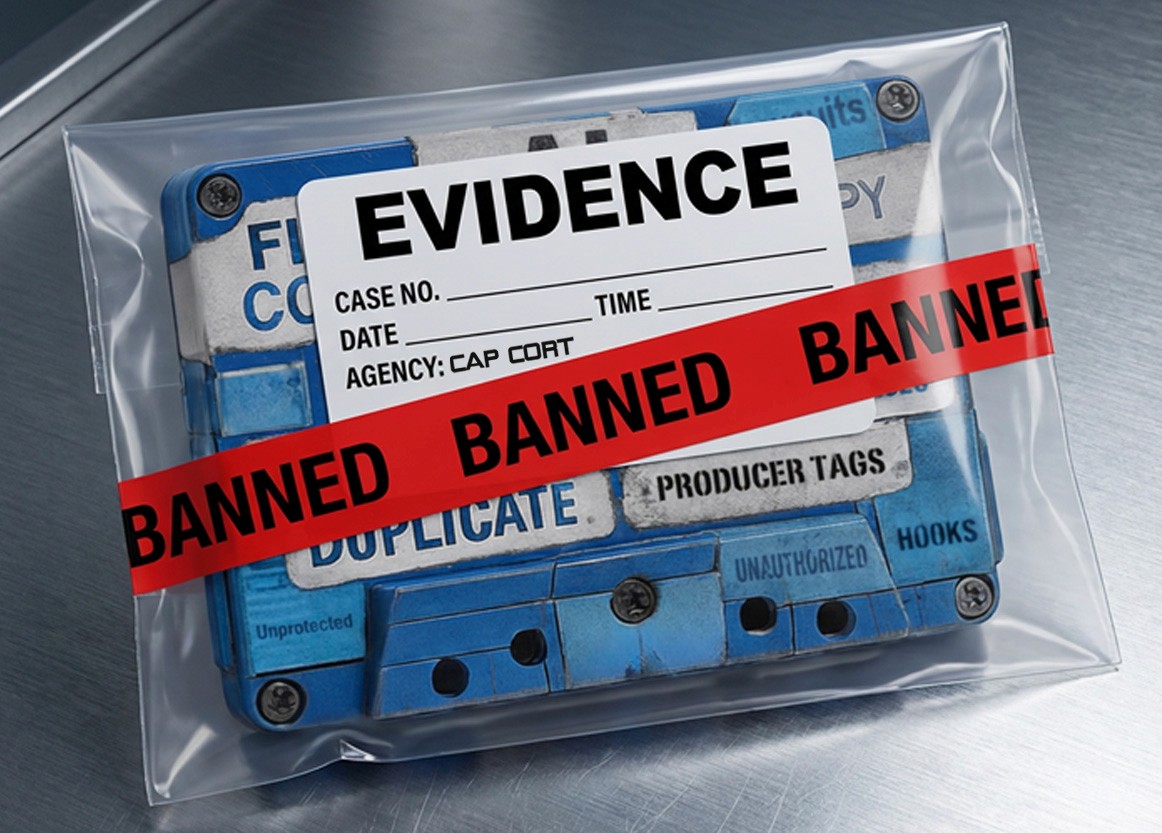
When an instrumental has no clear copyright protection, you lose control over how it can be used. And this opens the door to risks that most artists never see coming. These are some of the most serious ones and why they matter so much for your career.
Someone could sample your song and you would not be able to stop them
Under normal circumstances, if you owned the master and the copyright, you could demand compensation, negotiate splits or take legal action when someone samples your work.
But when a beat is generated entirely by AI, without human creative input, those protections may not apply.
Because that part of the song is not legally protected, anyone can sample it, reuse it, manipulate it or build their own track on top of it without owing you anything.
You cannot sue, you cannot request royalties and you cannot block the release.
It is an open invitation for others to profit from your music while you have no tools to defend it.
Someone could register your song under Content ID and remove you from platforms
This already happens with copyrighted songs, so imagine what can happen when the instrumental is unprotected.
Someone could upload your track before or after you distribute it, register it under Content ID and cause the system to identify their version as the original. Once that happens they could:
Block your monetization
Take down your release
Claim your earnings
Or in extreme cases remove your song entirely
And if the claim comes from a major company like Warner, Sony or Universal, overturning it becomes extremely difficult.
If this is already a problem for copyrighted music, an AI generated beat is even more vulnerable.
People could create remixes, covers or alternate versions and monetize them freely
If you do not own clear rights to the instrumental, anyone can create their own version, remix, reinterpret or cover your track without asking for permission.
And because the beat is not legally yours, you are not entitled to royalties, sync fees, licenses or any compensation at all.
They can monetize while you earn nothing.
Your viral song could be targeted if the instrumental was generated with AI
AI generated beats tend to share recognizable sonic patterns.
Producers with experience can often identify an AI instrumental by the way it sounds and by the artifacts that appear repeatedly in many AI outputs.
This creates a serious risk once your song starts gaining attention.
If another artist or even a label notices that your instrumental was created entirely by AI, they can recreate the instrumental themselves using real production techniques.
And here is the dangerous part.
A human recreated version can be copyrighted and registered as a new original work.
An AI-generated instrumental, without human authorship, cannot.
From there they could:
Release their own version while riding your momentum
Register the recreated beat under Content ID
Cause platforms to identify their version as the source
Put you in a position where your song gets flagged or removed
Benefit from your audience or confuse listeners with a nearly identical release
Because the beat in your track has no copyright protection, you have no legal foundation to defend it, even if you were the first to go viral.
And this leads to a tough reality most artists do not see coming.
The more successful your song becomes, the more vulnerable it is if the instrumental was generated with AI.
And the risks do not stop there
The lack of clear ownership over an AI-generated instrumental opens the door to even more vulnerabilities
Someone could re upload your instrumental or a recreated version, and platforms would not know who is right
Your beat could be used in ads, TV shows, video games or commercial content without paying you
Your instrumental could be turned into loop packs or sample packs and sold by other people
Anyone could distribute alternate versions of the track without your approval
These may seem like small threats at first, but once a song starts gaining traction they can snowball into problems that are almost impossible to reverse.
When Spotify removed a viral song overnight
One of the clearest signs that AI-generated music is entering more complex territory is what happened recently to a producer whose track went viral. The song earned millions of streams and over fifty thousand dollars in royalties before Spotify removed it without warning. Spotify removed the track and withheld the royalties, and according to reports, none of the income was ever paid out.
What makes this case even more shocking is that the beat was not generated with AI at all.
The producer created it himself.
The only AI element was the vocal transformation he used to change his demo voice into a different tone.
And that alone was enough for the entire release to disappear overnight.
A single AI generated vocal was enough to trigger a takedown
The situation escalated when listeners began assuming the vocal belonged to a well known artist. That raised concerns of impersonation, something Spotify’s policies explicitly prohibit.
Even though the producer never tried to imitate anyone, the AI transformation came close enough for the artist’s team to issue a takedown request. Spotify removed the track, withheld the royalties and according to reports none of the income was ever paid out.
To this day there is no clear path for the producer to recover the earnings or restore the original release.
Platforms are tightening their AI rules faster than most artists realize
This was not an isolated case.
Over the past year, major platforms have started adjusting their policies around AI generated audio:
Spotify has been testing automated AI detection systems and enforcing stricter rules
TikTok now labels AI generated music by default
YouTube requires creators to disclose AI usage, especially when imitating real voices
All these changes point to the same trend:
Platforms are moving toward much more aggressive moderation of AI generated content.
Even distributors are rejecting songs that contain AI elements
Several distributors have already started rejecting submissions that include AI generated sections, even when only part of a song uses AI. Some companies warn that if a track contains unlicensed AI material they may refuse to deliver it altogether.
And even if your release is accepted today, nothing guarantees it will stay online.
Policies are evolving quickly and a song that passes distribution now could be removed months later simply because an element of the beat was made with AI.
For independent artists this creates a new long term risk:
Your entire release can end up depending on a single unprotected piece of audio
When AI starts sounding a little too familiar
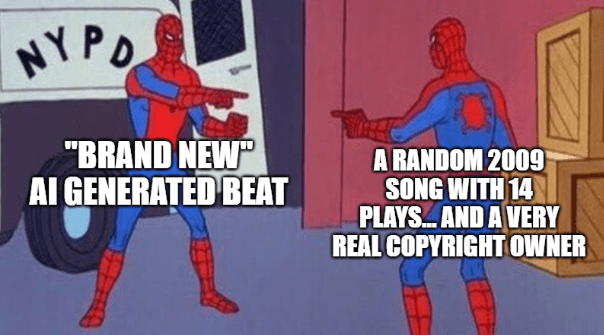
One of the most concerning examples we have seen is how AI models can sometimes recreate real producer tags.
There are documented cases where a user enters a simple prompt and the AI outputs a tag that sounds almost identical to the original, even though the user never requested it.
In some situations, generated audio has included well-known tags associated with major producers, the kind of sonic signatures that are instantly recognizable and legally protected.
If AI can recreate a tag, what else can it recreate?
Seeing something so specific appear in an AI generated track raises a difficult question.
If a model can recreate something as personal and distinctive as a producer tag, how many other musical elements could it be unintentionally copying?
AI models do not only learn styles. In some cases, they memorize.
Generative models are trained on extremely large datasets of music and audio.
In theory they should learn patterns and characteristics.
But in reality they sometimes memorize parts of the audio they were trained on and unintentionally reproduce them in new outputs.
This phenomenon is often referred to as memorization leakage.
And it means the AI might produce a melody, a riff or a musical part that matches an existing song so closely that it may feel like elements of the original recording are being reused.
There have been reports of users generating music that sounds surprisingly similar to real copyrighted tracks, even when their prompts had nothing to do with those songs.
The AI is not trying to copy, it is simply resurfacing patterns it absorbed during training.
And unless you recognize the original song behind it, you might release it believing it is completely yours.
This creates a double vulnerability for artists
When an instrumental is generated entirely by AI, without clear human authorship, you face two risks at the same time:
You may not be recognized as the legal owner of the AI-generated instrumental
You may unknowingly release material that infringes on someone else’s copyright
If the original creator recognizes the similarity, they do have the legal grounds to act, even if you had zero intention of copying anything.
And because the AI generated portion cannot be copyrighted or claimed by you, there may be very limited legal grounds to defend yourself.
There are still safe ways to create the music you love
When used as a creative aid or source of inspiration, and followed by meaningful human production, AI can still play a role in the creative process.
Many emerging artists turn to AI because it feels like the only accessible way to create music. And honestly, if these tools had existed when I started, I might have felt the same.
But there are safer and much more reliable ways to create songs that actually support your career rather than putting it at risk.
One of the most powerful is working with real producers.
Human collaboration gives you something AI cannot:
connection, intention, identity and full legal protection.
And you do not always need big budgets for that. Many emerging producers are talented, hungry and open to collaborating at accessible rates. Social media is full of opportunities to meet them.
Show your work.
Show your voice.
Let people connect with you.
If you are not ready for custom production, beat leasing is a safe and affordable way to release music professionally.
I license many of my beats from fifty dollars for exactly this reason, to give new artists access to quality music without putting their careers at risk.
If you are curious about how beat licensing works, I have an article on my site that explains it clearly. Feel free to take a look.
It is a path that respects your art and protects your future, something AI still cannot do.
Conclusion
AI is moving fast and in many ways it is fascinating.
It opens creative doors, sparks ideas and gives new artists a chance to experiment. But when it comes to releasing music professionally, the reality is very different from what these platforms promise.
The legal landscape is still evolving.
The ownership of AI-generated audio remains fragile.
And platforms are already taking action in ways that directly affect artists.
A single AI-generated element in a beat, when it lacks clear human authorship, can put an entire release at risk, even if the rest of the song is fully yours.
That said, this does not mean AI has no place in the creative process.
When AI is used as a tool for inspiration or ideation, and the final beat is composed, arranged, and produced through human creative decisions, the situation is fundamentally different from releasing a fully AI-generated instrumental.
If you take your career seriously, you deserve tools that protect you.
You deserve songs that are entirely yours.
You deserve the confidence of knowing that no one can take your track down or claim your instrumental with a single prompt.
AI can help. It can inspire. It can speed up ideas.
But it cannot replace the value of real collaboration, real creativity or the connection that happens when artists and producers build music together.
And today more than ever, working with real creators or licensing beats safely through beat leasing is not just the more professional path.
It is the path that protects your future.
If this moment teaches us anything, it is this:
The music you care about deserves a foundation that will not disappear tomorrow.
So experiment. Explore. Have fun with technology.
But build your career on something solid, something real, something that will still belong to you years from now.
Article written by Miguel Cort